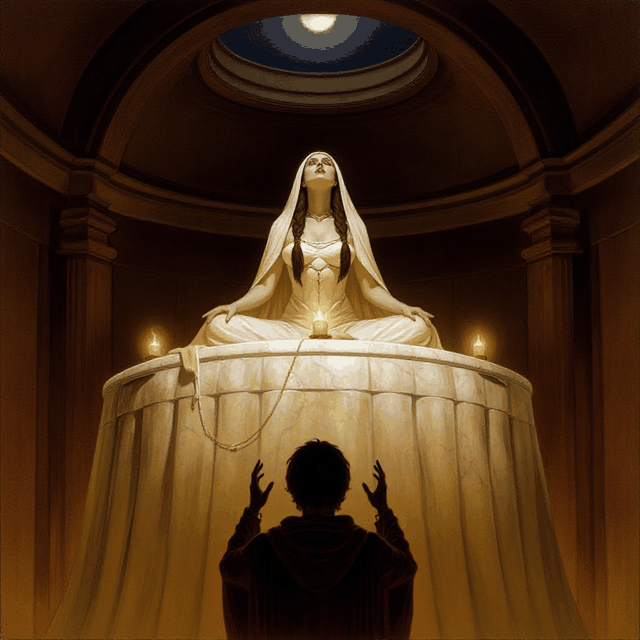
A priestess has spent seven years perfecting a rite of devotion that never once turned toward her. On the longest night of the year, a mistranslation a thousand years old finally gets corrected, and the altar she's knelt at since she was seventeen becomes something else entirely.
Good evening. I'm Lilith, and these are Letters to Lilith.
I promised you a letter from a Sun-Court that got its own scripture wrong for a thousand years, and here she is. Delia has knelt at that altar every Solstice since she was seventeen — devout, exact, giving a rite so perfectly that nobody, herself included, ever asked what she might be owed in return. This year the Chief Oracle cleaned an old scroll and read one corrected verse aloud, and the whole liturgy turned inside out in front of the entire court.
What she didn't know: her Devotee, the man who's knelt beside her for twelve years, had already found the correction himself, years earlier, and told no one. He'd been practicing the words he wasn't allowed to say to her since she was twenty-two, waiting for a night he wasn't sure would ever come.
This is her letter.
Dear Lilith,
I knelt for seven years before I found out I'd been kneeling in the wrong direction.
You should know how the rite works, or worked, or how I thought it worked, because none of what happened after makes sense without the shape of what came before. Every Solstice Vigil since I was seventeen, I have spent the longest night of the year on the altar stone at the center of the Sun-Court, offering the god the old liturgy word for word: the anointing, the twelve names, the hour of stillness where a priestess is meant to empty herself out so completely that something larger can pour in. My knees know that floor the way a tongue knows the gap where a tooth used to be. I could recite the closing verses in my sleep. I have, actually. Hyperion told me once that I mutter the fourth invocation in my dreams, word-perfect, and I believed him, because dreaming in liturgy is just what happens to a woman who has given the same seven hours of devotion, precisely, every year, since before she'd had a man's hands on her for any other reason.
Here is what discipline does to a body over that many years. It doesn't numb you. People assume that it does, that the woman who performs the rite flawlessly must feel the least of anyone in the room. Wrong. Discipline sharpens the wanting. Every year I knelt in the resin-thick air, breathing incense that always caught at the back of my throat exactly two breaths before it stopped bothering me, and underneath the recitation ran a second voice, quieter, that I never let anyone hear. It asked, every single time: what would it be like if this were for me.
I never answered it. That wasn't my role. The role was: give.
This year the Chief Oracle read the founding scroll aloud before the vigil began, because the parchment had finally been cleaned enough to read the oldest layer beneath the copyist's ink, and what she found there undid a thousand years in about forty seconds. The original grammar of the ninth line, the one every priestess since the founding has translated as she gives herself to the flame's hunger, doesn't run that direction at all. The verb is reflexive the other way. It should read: the flame gives itself to her hunger. One vowel mark, copied wrong by some anonymous scribe a millennium ago, tired or careless or maybe just unable to imagine the sentence any other way, and every priestess after him inherited his mistake like a birth defect. We had been offering ourselves to a god who was always meant to be offering himself to us.
The court went silent in the specific way a room goes silent when nobody can be first to speak. I looked for Hyperion instinctively. Twelve years my senior in service, the Devotee who has stood at my shoulder through every vigil since I was old enough to hold the ceremonial blade steady. I expected him to look as struck as everyone else.
He didn't look struck. He looked like a man watching a door finally open that he'd had his hand pressed flat against for longer than he wanted anyone to know.
That's the part that changes everything about how I've thought about that night since. I assumed the correction was news. I assumed we were all discovering it together, priestess and Devotee and Oracle alike, and that whatever came next would be two people fumbling forward into something neither of us had words for yet.
Hyperion had words for it. He'd had them for four years.
He told me later, after, when the candles had burned down past the second ring and neither of us had bothered to relight them, that he found the same variant in a fragment kept in the lower archive, the year I turned twenty-two. He didn't take it to the Oracle. He said he was afraid of what it would mean to be believed too soon, before I was ready to hear it, before he was ready to be the one who said it to me. So he sat on it. Four years he served at that altar knowing the rite ran backward from how we performed it, watching me give and give and give, and never once said a word.
"What did you do instead," I asked him, and my voice came out rougher than I meant it to.
"I practiced," he said. Not proud of it. Almost embarrassed. "Alone. At night, after you'd gone. I said the corrected verses to an empty room so that if the day ever came, I wouldn't stumble over them in front of you."
Four years of a man rehearsing prayers he wasn't allowed to say, to a woman who didn't know she was the one they were meant for. I have turned that thought over more times since the Vigil than I can count, and it still catches somewhere under my ribs every time.
The Oracle dismissed the court an hour before midnight, an unprecedented mercy, granted, she said, so that "the correction might be honored properly." The sanctum emptied out fast, the way a held breath leaves a body once someone finally says it's safe to let go. Braziers still lit around the perimeter. The roof open above us to a sky that the old liturgy insists won't fully darken until the rite completes, though I've never once, in seven years, actually watched to see if that's true.
Hyperion and I were alone on the altar floor for the first time in either of our lives with nothing scripted left to say.
I walked to the stone first. Nobody led me there; I want that on record. Marble under my knees again, the same marble, but different now that I knew what direction it was supposed to run. He came and knelt in front of me, not beside, in the old serving posture, out of a decade of habit more than intention, and I remember reaching down and putting two fingers under his chin and lifting his face up to mine.
"Not tonight," I told him. "Not like that."
He rose. I have watched that man move for twelve years, hauling braziers, carrying the ceremonial vessels, kneeling and rising a thousand times in perfect liturgical rhythm, and I had never once watched him rise like that. Unhurried. Like a man finally allowed to stand at his full height in a room that had always required him small. He's taller than the doorframes of the outer hall. I'd forgotten, somehow, in all those years of watching him kneel.
I undid the cord myself. Cream-colored, woven from the same fiber the liturgy braids into every offering, kept coiled at the altar's base for the binding rite that always went the other direction: priestess bound, god unbound, myself handed over year after year to a hunger I was never permitted to have back. I took it up and looped it once around his wrists, loose, more gesture than restraint, because I wanted the old shape of the rite present even as I broke it. He let me. His pulse jumped under my thumb when I drew the knot snug, and I felt something in my own chest answer it, hard, low, nothing like the disciplined stillness I'd spent seven years perfecting.
"Say it," I told him. "The verse you practiced. All four years of it. Say it to me now, out loud, the way you meant to the first time."
His voice, when he found it, had none of the flat liturgical cadence the court trains into every Devotee. It cracked once on the second line. The flame gives itself to her hunger. Then the rest of it, words I'd never heard, because they'd been excised from every copy but the one buried under a scribe's careless mistake, a passage about the god kneeling, the god's mouth finding devotion in a woman's body instead of demanding it from her spirit. He said all of it looking straight at me, cord loose around his wrists, and by the third line I'd stopped being able to sit still through it.
I pulled him down by the collar of his robe and kissed him first. That matters too. Seven years I had waited for permission that never should have been required, and I was done waiting for anyone to grant it to me a second time.
His mouth was rougher than I expected, chapped from four years of silent recitation in cold archive rooms, I'd guess, though I didn't ask that night and I've never asked since. What I noticed instead: the sound he made low in his chest when my tongue traced the seam of his lips, a sound with none of the Devotee's practiced restraint in it at all. His bound hands came up anyway, cord and all, and found my hips, and I let them, because the whole architecture of that rite was mine to redraw as I pleased.
He got my robe open with his teeth on the shoulder-clasp, which should have been impossible with his wrists tied and wasn't, and I felt the night air of the open roof find my collarbone, my breastbone, skin that had never once been bared in that room except under strict liturgical instruction about which hour, which gesture, which god's-eye angle. This time nobody was watching but him. He looked at me the way I imagine the old, uncorrupted verse always meant a god to look at a woman: devotion as a hunger that ran both ways, mistranslated for a thousand years.
I sank my hands into his hair and pulled his head down.
His mouth found my breast first, unhurried despite everything in his body straining against that. Teeth grazed, careful, then not so careful, and I heard my own breath go ragged in a way I don't think that sanctum had heard from me in seven years of composed devotion. He worked lower, the old serving posture again but inverted, kneeling this time to give my body the attention the god had always claimed for himself. His mouth found my clit through nothing at all, because I'd already shed everything the rite required, and the first drag of his tongue against me made the whole room tilt.
I'd touched myself before. Alone, guiltily, in the dark of my sleeping cell, always quick, always finished before the thought could fully form into something I'd have to name aloud to the Oracle in confession. Nothing in seven years of my own hand prepared me for a man kneeling at an altar with his wrists bound in the court's own cord, worshipping me like the correction had been carved into his bones years before the parchment ever confirmed it. He built something in me slow and then not slow at all, one hand braced against the marble because my knees had gone unreliable, the other still fisted in his hair, and when I came the first time it tore out of me loud enough that I heard it echo off the domed ceiling and didn't care who might still be near enough to hear.
He didn't stop. I had to physically pull him up by the shoulders, laughing and shaking at once, because if he'd kept going I'd have come apart entirely before I got what I actually wanted, which was him.
I mounted the altar the way the old verse describes the god descending. The verb, corrected, belongs to me now. I straddled him where he knelt, still bound, robe shoved down around his hips, and took him inside me in one slow drop that had us both making a sound neither of us tried to soften. The marble was cool under my knees, warmer where the brazier-light had been reaching it all night, an unevenness I felt with every shift of my weight. I set the pace from the first thrust, not fast yet, a deliberate roll of my hips that let me feel every inch of him and let him feel exactly how little patience I had left for the disciplined stillness of seven years' training.
"Delia." He said my name like it was a fifth invocation nobody had ever written down. His bound hands found my waist, my thighs, wherever I let them land, and I rode him harder when I felt his self-control start to fray under my palms.
I reached down between us at some point. I genuinely don't remember when; the whole encounter has that quality now, precise in flashes and blurred everywhere else. I freed his wrists myself, because I wanted his hands on me without the cord's excuse for restraint. He used them well. One splayed wide against the small of my back, angling me exactly where I needed the friction; the other found my breast, my throat, the curve of my jaw, like a man cataloguing a body he'd spent four years imagining and needed, now, to confirm against memory.
I came again with his name breaking on my tongue and his hand fisted in my hair, and this time I felt him go rigid beneath me a few strokes later, groaning something that might have been my name again or might have been the last line of that hidden verse, I truly couldn't tell you which, and it didn't matter. The room held both sounds the same.
We stayed tangled on the altar stone long after the braziers had burned down to embers. He told me about the archive, the fragment, the four years of practicing to an empty room. I told him about the second voice under seven years of recitation, the one that kept asking what would it be like if this were for me, and how strange it was to finally get an answer that didn't come from patience running out but from a scribe's ancient mistake finally getting fixed.
I looked up once, near the end, to check whether the old superstition was true, whether the sky really doesn't darken until the rite completes. It hadn't. Full night, stars sharp and close through the open roof, the vigil long since finished by every measure that used to matter.
I don't kneel at that altar the same way anymore. I still serve the Sun-Court; the correction didn't undo my calling, only its direction. Every Solstice since, Hyperion and I have performed the rite exactly as the original scroll intended, and the court has stopped pretending it doesn't know what that means for the hours after the public liturgy ends.
Four years he waited and said nothing. I think about that more than almost anything else from that night. More than the altar, more than the sound the room made when I finished the first time. A man kneeling alone in a cold archive, memorizing devotion for a woman who didn't yet know she was allowed to receive it.
I am glad the scroll was cleaned. I am gladder still that he never stopped rehearsing.
Yours in the corrected verse, Delia
And so...
Seven years of devotion given exactly right, and it turned out the mistake was never Delia's — it was a scribe's, a thousand years dead, who couldn't imagine the sentence running the other direction. That's worth sitting with. However carefully you've learned to give, however good you've gotten at it, ask yourself whose translation you're using, and whether it's due for a correction. Your wanting was never the error. Empower yourself to read it right.
Next week, we trade the altar for a warm stone terrace above the Mediterranean, and a woman who has spent her whole careful life managing everyone else's appetite but her own. Then she meets a man who treats her body like a meal worth lingering over, and discovers what happens when someone refuses to be rushed. We're calling it The Feast, and dear listener, come hungry.
Thank you for listening, I'm Lilith, and this is the Letters to Lilith podcast. Remember, I left Eden so you wouldn't have to. Now go and explore your pleasure.
Want to live this one together? The Encore for “The Worship” — a re-enactment kit for you and your partner.