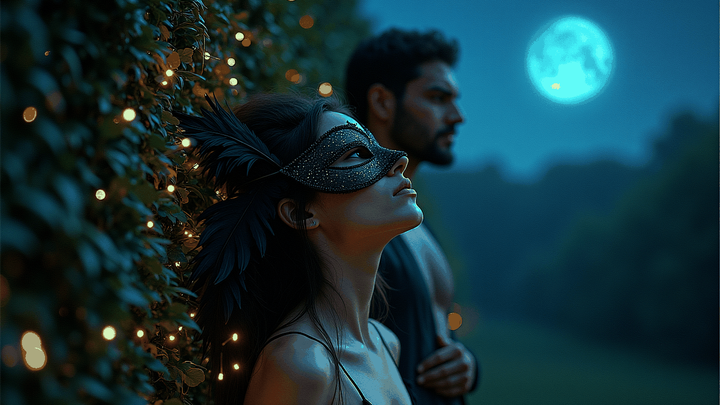
She has spent years running her life down to the hour, verifying every trust before she gives it. At an ageless fae court's masquerade where masks are worn as a condition of entry and no references exist, she lets a stranger undo her exacting composure entirely — only to discover he is the man she turned away months earlier for being too proper, now made entirely new to her behind a mask.
Good evening. I'm Lilith, and these are Letters to Lilith.
Tonight our letter arrives from a daughter of Virgo, the precise disciplinarian who has never once let herself be disorganized in public. I read her as the woman who has organized every desire in her life except the one that wants to be told what to do.
Her name is Elara. She has spent years running her late husband's estate and her own life with meticulous precision, down to the hour, trusting only what she can verify: reputations, references, ledgers, the particular shape of a person's competence. But when she steps through the gates of an ageless fae court's masquerade, where masks are worn as a condition of entry and no names may be spoken, no references given, no reputations claimed, she finds herself drawn to a masked stranger whose competence she cannot catalog. In a court with no calendar and no clock, where the only verification system is the evidence of bodies and want, she must choose between her need for control and her hunger for something she cannot confirm.
What she finds in that hedge-maze alcove will ask her to confront whether her verification systems have been protecting her all these years, or simply limiting her.
This is her letter.
Dear Lilith,
I have spent years running my late husband's estate down to the hour, and I have spent those same years running my own life with the same meticulous precision. I know what time I wake, what time I break my fast, what time the accounts must be balanced, what time the year's ledger must be closed. I know the reputations of every man and woman who does business with my household. I know their references, their credit history, the particular shape of their competence. I am, Lilith, a woman who verifies before she trusts. It is how I have stayed solvent and solitary and safe.
Six months ago, a fae lord presented himself at the gates of a court I had only heard of in whispers. The Masquerade of the Unnamed Court, where masks are worn not for a single night but as a condition of entry. He wore no mask then. He stood at the gate in the ordinary twilight of the mortal world, and he introduced himself with a name I cannot remember now and a manner that was perfectly, excruciatingly proper. He explained the court's rules: that masks are required within, that no names may be spoken, that no references may be given, that no reputations may be claimed. He invited me to enter, and I looked at him. Tall, composed, with the kind of well-bred face that suggests a man who has never once surprised anyone in his life. And I turned away.
I told myself it was because I did not have time for games. I told myself it was because an estate does not run itself. The truth, which I would not admit even in the privacy of my own thoughts, was that he frightened me. He was too legible. Too easy to verify. Too much the kind of man whose competence fits neatly into a ledger, and I have spent years avoiding precisely that kind of man. I wanted something I could not predict.
I did not know, then, that the court would find me anyway.
The invitation came three weeks later, sealed in wax the color of twilight. When I broke the seal and read the words, an invitation to the Masquerade, mask required, no names spoken, no references given, I found myself pulling on my darkest cloak and walking to the gate at the edge of the property before I had made a conscious decision to go.
The mask was waiting for me at the threshold. A raven mask, black as the void, with laces that fastened behind the head and a slit for the mouth that left only the lower half of my face exposed. I put it on, and the moment the laces were tied, the world shifted. The mortal twilight fell away, and I stepped through the gate into a court that has no calendar, no clock, no moon that moves.
I have described it to others since, and the words always fail. Hedge-mazes as tall as houses, lit from within by will-o'-wisps in soft gold and pale blue. Alcoves cut into the living green walls, each one private, each one waiting. Court wine that never runs out, tasting of honey and something deeper, salt and iron. A moon suspended in a sky that is always twilight, never moving, never marking time. And everywhere, masked figures circling each other in the slow, deliberate dance of strangers who cannot verify and therefore cannot fully trust.
I walked the maze for what might have been hours or might have been minutes, because time does not exist there. I watched the masked figures, wolf masks and fox masks and masks shaped like things I had no names for, and I felt the unfamiliar sensation of being unable to place anyone. No reputation to assess. No references to check. No way to know whether the man in the lion mask was a prince or a pauper, whether the woman in the swan mask was a thief or a saint.
And then he stepped out from an alcove, and I knew him immediately, though I could not have said how.
His mask was different from the others. Not an animal mask, but a half-mask of black silk that left his jaw and mouth exposed, framed in silver. His body was the same height as the fae lord at the gate, the same breadth of shoulder, the same stillness in the way he held himself. But behind the mask, in the charged twilight of the court, he was not proper. He was not legible. He was entirely, maddeningly new.
He did not speak. He watched me, his eyes dark behind the silk half-mask, and I felt the most absurd urge to run toward him and away from him in the same breath. I stood my ground. I am, after all, a woman who has spent years refusing to be moved by anything she cannot verify.
"You," I said, because it was the only word that would come.
"You," he agreed, and his voice was the same voice I had heard at the gate, transformed. The register was familiar, low and measured, but something in it had changed. Some restraint had fallen away. The proper fae lord who had stood in the mortal twilight was still in there somewhere, but the mask had done something to him. Loosened him, or perhaps freed him. The result was a man I did not know and could not catalog.
"I turned you away," I said, because verification is how I process everything, even here.
"You did," he said. "And you were right to do it. The man you met at the gate was too easy to read. Too comfortable in his own certainty. I have spent months wishing I had been less proper."
My pulse jumped hard enough that I felt it in my throat. I stood in the will-o'-wisp-lit hedge, wearing a raven mask that hid everything except my mouth, and I felt the precise, disciplined system I had built around myself begin to splinter. Because here was a man admitting, plainly, that the very thing I had rejected about him was the thing he wished to change, and the confession landed in me like a knock at a door I had thought locked forever.
"I don't know your name," I said.
"You won't," he said. "That's the point. No names here. No references. No reputations. Just what your body tells you mine is."
"And what is that?" I asked, and I heard the challenge in my voice, the way I always hear it when I am terrified and refusing to show it.
"Competent," he said. "Patient. Interested. Willing to let you verify the only way that matters here."
He stepped closer, and I did not step back. The hedge behind me was solid, alive, will-o'-wisps flickering in its depths. His hand came up, slow, giving me every chance to refuse, and when his fingers brushed the raven mask's edge, finding the laces at the back of my neck, I felt my breath catch in my throat.
"You don't have to take it off," he said, low. "But I'd like to see your eyes."
I let him. I stood still while his fingers worked the laces, and when the mask fell away, I looked up at him with my face exposed and felt the most terrifying vulnerability I had known in years. Because now he could see me, really see me, without the raven's protection, and I had no way to verify what he saw in return.
"You're beautiful," he said, and it was not a compliment. It was a report. The way a navigator reports a bearing. He said it the way he said everything true, as though the fact of it was more important than whether I was ready to hear it, and his eyes moved over my face with the same attention he might have given a ledger, thorough and patient and hungry in a way he rarely let show.
"Stop looking at me like that," I said, and it came out sharper than I intended, a sudden spike of fear in a voice that was supposed to remain composed.
"Like what?"
"Like you're reading me. Like you're verifying something."
"I am," he said. "I'm verifying that you want this as much as I do."
I wanted to deny it. I wanted to retreat behind the raven mask and the ledger and the system I had built. But his hands were on my waist now, warm and sure through the silk of my gown, and my body was already answering a question I hadn't asked it to weigh, the slow, deliberate build of want I had been suppressing for years.
"I can't verify you," I said, and the words came out small, almost frightened, because this was the thing that terrified me most about the court: the absence of any system I could use to make him safe. "I don't know your reputation. I don't know your references. I don't know if you're trustworthy. I don't know anything about you except what you've told me, and that's not proof, that's just..."
"Words," he finished for me. "Yes. I know."
His grip on my waist tightened, just enough to pull me closer, and I felt the full length of him against me, hard and warm and real, and my mind, the part of me that has spent years organizing chaos into submission, short-circuited entirely. Because here was something no ledger could argue with, evidence my body recognized before my brain could process it, and the contradiction between "I don't know if he's trustworthy" and "he is holding me like he has waited months for this" was the most disorienting thing I had ever felt.
"Tell me to stop," he said, low against my ear. "Tell me to walk away, and I will."
I couldn't. I stood in the will-o'-wisp-lit alcove with his hands on my waist and my mind reaching for a verification system that didn't exist here, and I made the choice that I think you, Lilith, of all people, would understand. I chose to trust competence I could not confirm. I chose to let myself want something I could not catalog.
"Don't stop," I said, and the words came out like a surrender.
He kissed me then, and I had expected precision, the same measured control he had shown at the gate. What I got was something else entirely. His mouth was warm and urgent, opening mine with a thoroughness that suggested he had been imagining this for months, and I felt my composure, the careful structure I had maintained for years, fracture along every seam. I made a low raw noise into his mouth that I could not have stopped if my life had depended on it, and my hands slid from his sides to the back of his neck and I held on.
We did not rush. There was no midnight to end this masquerade, no clock to count down, no calendar to mark the passing of time. The court exists outside of time, and we existed within it with the same impossible suspended quality. He undressed me slowly, with hands that had learned exactly where to touch, and I let him, because the wanting was larger than the fear, and the fear was the thing that had kept me safe for years and I was done with safe.
The silk gown fell away, and then the shift beneath it, and I stood in the hedge alcove naked under the moonlight that never moved, his hands on my skin. His mouth traced my throat, my collarbone, the place below my ear where my pulse was hammering, and I arched into it because I had forgotten, in years of holding still, how much my body wanted to be touched by hands that knew it.
"I don't know your name," I said again, because some part of me was still trying to find a way to verify him, to make him fit into a system I could understand.
"You don't need it," he said against my skin. "You know what I am."
"And what is that?"
"Yours," he said, and his fingers traced the place between my thighs, warm and deliberate, and my hips rose off nothing, searching, because my body knew him even if my mind couldn't place him. "I could do this for hours," he murmured against my ear. "Just watching what happens to you."
He was unhurried. He kissed the soft skin of my thighs until I was shaking, and when his touch traced into me it was with the same maddening, reverent thoroughness he brought to everything, slow and exact, learning me as though months of waiting had taught him exactly what I needed. It had. He discovered the rhythm that unraveled me and kept it, steady, and I twisted my hands in the living hedge and the will-o'-wisps flickered around us and I did not care. I was past caring. I was a woman in a timeless court being touched by a man I could not verify and the scale of that and the physical reality of his fingers on me were the same thing, indistinguishable, want and fear and curiosity all braided into one.
I came with his name, or a name I gave him because I could not bear the emptiness of not having one, in my mouth, and it was not quiet, and I was not composed, and I did not try to be. The climax shook me the way an earthquake shakes a foundation, long and rolling, and he held me through the whole of it, his hands on my hips, his mouth gentle now, easing me down, and when I could breathe again I reached for him and found him shaking too, and the knowledge that he had been holding himself in check all this time, patient even now, cracked me open a second time, in a different register.
"Come here," I said, and pulled at him, and he came up over me, and I felt the full length of him, hard and warm and real against my thigh, and I wrapped my hand around him and his breath broke on a groan that I felt against my neck, and the sound of it, the rawness of a man who has waited, went through me like a current.
"Now," I said. "I'm done waiting. I've done enough waiting for a lifetime."
He bent and lifted the raven mask from where it had fallen in the moss, and instead of setting it aside he held it out to me. "Keep this on for me," he said, low. "I don't want to watch your face and confirm anything. I want to feel it." I let him lace it over my eyes again, his fingers sure and steady at the back of my neck, and something in that reversal went through me sharper than his hands had: him choosing not to watch me either, this stranger handing me back my anonymity in the very moment I meant to give him everything else.
He turned me around then, with the same deliberate sureness he'd shown all night, and I faced the living hedge with my hands gripping the green wall and felt him behind me, his chest against my back, his hands on my waist. The position was entirely new to me. I had never taken a lover from behind, had never even considered it, yet the thrill of it, the sheer strangeness of it, went through me like lightning.
"Is this alright?" he asked, low against my ear.
"Yes," I said, and it was the truest word I had spoken all night. "Yes. Don't stop."
He entered me slow, and over my shoulder I watched what the raven's slit let him see of me, my mouth open on a breath I couldn't hold back. I felt every inch of the long slide, and I didn't look away, because looking away felt like a concession to the fear I was not willing to make. When he was fully inside me we both went still, breathing hard, and the will-o'-wisps flickered around us and the moon that didn't move watched everything, and the knowledge that I was here, in this timeless court, masked and anonymous and utterly known, taking pleasure in a way I had never allowed myself before, was so large and so simple that it emptied me of every clever thing I had ever told myself about safety.
He moved. Slow at first, deep, the same steady rhythm he had kept all night, and I met him, and my body learned his the way a mind learns a new language, and the pleasure built in long waves that I could not rush no matter how I tried. I stopped trying. I let it build the way it wanted to build, slow and total, and when it crested it took me under completely, my whole body clenching around him, and I heard myself say things I will not repeat because they were private and desperate and true.
He followed. Not at the same moment, not the neat twin climax of a story, but after, his own control at last giving way on a sound I had never heard from any man. His whole body went rigid against my back and then he spilled into me with my given name on his breath and his face buried in my neck, and I held him through it, my hands locked on the living hedge, my body taking everything he gave me, refusing to let go even a fraction.
We stood tangled in the hedge alcove while the will-o'-wisps flickered and the moon that didn't move watched us with its impossible blue light. His hands located the laces at the back of my neck without asking this time, and when the raven fell away again I let it, my face bare to him for the second time that night. I ran my hands over every part of him I could reach, memorizing him against the dawn that would never come, and he let me, his eyes half-closed, his thumb tracing slow circles on my hip.
"I still don't know your name," I said, quiet.
"You don't need it," he said again, his voice gentle now. He understood that my need for verification was a habit I had built to keep myself safe, and that letting it go was the hardest thing I had ever done.
"I need something," I said. "I can't just be here without something to hold onto."
"You have this," he said, and his hand covered mine where it rested against the living hedge. "You have the memory of this. You have the evidence of your body. That's verification enough, Elara."
He knew my name. He had known it from the start, in a court where names are not supposed to exist, and the knowledge that he'd known me without my knowing how cracked the last wall of the system I'd built. Wanting, it turned out, could be its own form of trust. Some things don't need to be proven to be true.
"I turned you away at the gate," I said, and it was a confession, not an accusation.
"I know," he said. "And I deserved it. The man I was then deserved it. The man I am now, the one the mask let me become, that's the one I wanted to be for you."
I pulled back then, just enough to see his face, really see it, and what I saw was not the proper, composed fae lord I had rejected months earlier. What I saw was a man who had used the mask to become someone new. Someone patient, someone hungry, someone willing to wait in a timeless court for a woman who needed to learn how to want something she couldn't prove.
"You're still him," I said. "The fae lord at the gate. But you're not only him."
"No," he said. "I'm not. The mask didn't hide me, Elara. It freed me."
I pulled him down to the hedge-maze floor, and he came, and the will-o'-wisps flickered around us and the moon watched, and I made love to him again, this time with my hands on his face and my eyes on his, learning him slow and deliberate, the way you learn a truth you've decided to trust rather than prove.
I don't know how long we stayed in that court. Time doesn't exist there. But when I finally pulled away and reached for the raven mask, lying on the hedge-maze floor where it had fallen, I felt different. Lighter. Less rigid. Less like a woman who needs to catalog everything and more like a woman who can let things be unknowable sometimes.
He helped me with the mask laces, his fingers sure against the back of my neck, and when the raven was in place again and only my mouth was exposed, he kissed me through the mask's slit, a long, thorough kiss that tasted of court wine and the salt of our sweat.
"Next time," he said against my mouth.
"There won't be a next time," I said, and I felt the truth of it like a stone in my chest. "I can't verify you, and I can't keep doing this. I can't keep coming here and not knowing."
"You can," he said. "You already have. You're here. You're wanting me. That's proof enough for tonight."
The court faded around us then, the way it does when the spell ends, and I found myself standing at the gate of my own property in the ordinary twilight of the mortal world, wearing a raven mask and carrying the memory of a night that had no clock and no calendar, only the evidence of my own body to say it had happened.
I walked back to the manor house with the mask still on and didn't take it off until I was in my own bedroom with the door locked. When I finally freed the laces and looked in the mirror, the woman looking back had darker eyes and a softer mouth, and somewhere behind them, in the place where she kept her ledgers, there was a new space that didn't need proof to be real.
I still run the estate down to the hour. I still check every reference before I sign a contract. But sometimes, when the twilight lasts longer than it should, I find myself at the gate, remembering a court with no calendar and no proof of anything except what my body knew.
I don't have answers, Lilith. Only the memory of his hands, his mouth, the hedge at my back, and the plain fact that my own pleasure was evidence enough. I wonder if that's enough to build a life on. Some nights, I think it might be.
With more curiosity than I know what to do with,
Elara
And so.
She went back, dear listener. She never verified him to her satisfaction, but she understood that some kinds of trust cannot be cataloged. The ledger she kept for years was never protection. It was just a way of being alone in a shape that looked like competence.
So here is my encouragement to you tonight: not everything worth wanting can be confirmed in advance. Sometimes the evidence you need is already in your hands, your body, the way someone touches you. Let yourself trust competence even when you cannot confirm it. The mask does not hide. It frees.
Until next time. I'm Lilith. I left Eden so you wouldn't have to. Now go and explore your pleasure.
Want to live this one together? The Encore for “The Mask” — a re-enactment kit for you and your partner.