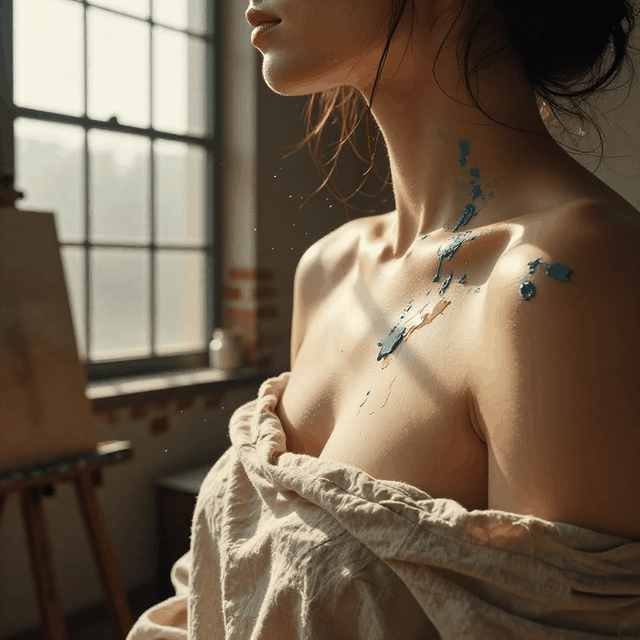
A life model who thought she knew every rule of being looked at meets the one painter who never touches his subjects — until a four-hour sitting in a June-lit studio breaks a rule he built for exactly this reason.
Good evening, dear listeners. I'm Lilith, and these are Letters to Lilith.
Tonight's letter opens our first season, and it arrives from a woman named Danni, a life model in a converted dye mill, the kind of building where the walls still remember the work that used to happen in them. She has posed for painters for six years and learned to leave her body on the platform while her mind wandered off somewhere warmer. She thought she understood the whole transaction. Undress, hold still, get paid, go home unmoved.
Then she sat for a painter with a rule. Six years he's kept it, with every model who's ever climbed his stairs: he does not touch. And on one long June afternoon of gold light and turpentine and hours of being looked at more patiently than she has ever been looked at in her life, Danni discovers there is a difference between being seen and being looked at, and a third thing entirely, waiting underneath both, that she never had a name for until it found her.
This is her letter.
Dear Lilith,
I have been looked at for money more times than I can count, and I always thought I knew the difference between being seen and being looked at. Turns out I didn't. Turns out there's a third thing, and I found it on a Thursday in June, on a platform draped in linen, in a dye mill that hasn't dyed anything in eighty years.
I model. Have for six years, since art school ran out of money and I discovered I could make more sitting still than I ever made painting badly myself. It's a good trade if you can stand the cold and the boredom. You learn to leave your body on the platform and let your mind wander off somewhere warmer. I've done this so many times that most sessions blur together: a stool, a space heater, a painter squinting at me like I'm a problem in perspective. I don't think about the men and women who've painted me. I think about grocery lists.
Ruben Deschamps is different, and I knew it the first time I climbed the freight stairs to his studio and he didn't look up from the canvas he was already working on to say hello. He said, without turning, "Robe on the hook. Take your time." Like I was a guest, not a job. Six years he's had one rule with every model who's ever sat for him, and everyone in this building knows it: he does not touch. Not to adjust a pose, not to brush a stray hair off a shoulder. He talks you into position with his hands hovering an inch from your skin, describing the angle he wants until you find it yourself. Painters gossip about it the way people gossip about monks. Some find it eerie. I found it, from the first session, unbearably erotic, though I would not have admitted that to anyone, least of all him.
I'd sat for him four times before this one. Portraits, mostly, quick studies, an afternoon here and there over two years, paid on time, no complications. Then in May he asked if I'd sit for something longer. Private, he said. Not for the gallery. He wouldn't tell me what it was for. He offered triple my rate and said only that he needed hours, not minutes, and that I should wear whatever I wanted underneath the robe because I'd be under a sheet at first and then not.
I said yes before I'd finished doing the math on why.
The Thursday came hot and close, the kind of June day that makes the whole city smell like tar and cut grass. His studio takes the top floor of the mill, sash windows the size of doors on the west wall, and by two in the afternoon the light comes in low and buttered, thick with dust turning slow gold in the air. I climbed the stairs with my bag over my shoulder and found him already at the easel, a raw canvas stretched and gessoed and blank, jars of pigment lined along the trestle table like a chemist's shelf: cerulean, raw umber, a red that looked almost obscene next to the others.
"You're early," he said.
"You said hours. I figured I'd need the extra time to get comfortable."
He almost smiled. He has this way of nearly smiling that costs him more than a whole grin would cost anyone else. "Robe's on the hook."
I undressed behind the folding screen he keeps for that purpose, though after four sessions we both know it's a formality, a kindness more than a barrier. I kept my underwear on, the black ones, no particular reason except that some instinct told me to. When I came out in the robe he had the platform arranged already: a low wooden dais with a linen sheet thrown over it in loose folds, one bolster for my head. He positioned it near the tall window so the light would fall across me at an angle he'd clearly already worked out in his head, maybe for days.
"Lie back," he said. "Left arm above your head. Let the sheet fall where it falls, don't arrange it."
I lay down. The linen was cool against my shoulder blades, then warm where the sun found it. He came close to adjust the sheet's fall with two fingers, the way he always does, careful not to touch skin, his breath grazing warm across my collarbone where he bent down — turpentine first, then something warmer underneath, cedar maybe, soap. His fingers hovered a half-inch above my collarbone.
"There," he said, to himself as much as to me, and stepped back to the easel.
Four hours of being looked at like that does something to a person, and I don't think I understood it until it was happening to me. He didn't talk much. He'd ask me to breathe out and hold, to turn my chin a fraction, to let my hand go loose instead of curled. Every request came with his eyes moving over me the way his brush moved across canvas, patient, in no rush to arrive anywhere. Most people who look at a naked woman are looking for something specific, checking a box, moving on to the next thing they want. Ruben looked at my collarbone like it was the only interesting collarbone that had ever existed. He looked at the crease where my hip met the sheet like he was reading a sentence he wanted to memorize. Twenty minutes could pass where the only sound was his brush against the palette, the particular wet drag of it, and the traffic six floors down, and my own pulse, which I became newly, uncomfortably aware of.
By the second hour my shoulder ached from holding the pose and I didn't want him to stop. That was the strange part I couldn't explain to myself at the time. The stillness should have been tedious. Instead it felt like something was being built between us with every minute that passed and neither of us was allowed to name it, a pressure with nowhere to go, gathering in the room the way heat gathers under a window on a day like that one.
"You're moving your hand," he said once, not unkindly.
"Sorry."
"Don't apologize. Just be still." A pause, brush still against canvas. "You're very good at this. Better than most."
"At holding still?"
"At being looked at." He said it like he was naming a skill most people never bother to learn, an unusual, specific compliment, and something low in my stomach turned over.
I asked him, somewhere in the third hour, what the painting was for, since he still hadn't told me. He was quiet long enough that I thought he wouldn't answer.
"For me," he finally said. "I don't sell this one."
"Why not?"
"Because I don't want anyone else to have it." He said this plainly, the way he says everything, without drama, and went back to mixing color, and I lay there with that sentence lodged somewhere under my sternum, working itself in deeper the longer I turned it over.
I should tell you, Lilith, that I have never once in six years of this work felt what I felt lying on that platform. Desire, usually, announces itself fast: a look across a bar, a hand at the small of your back. This built like weather instead, slow enough that I could feel each stage of it arrive and settle before the next one came. First just a heightened awareness of my own skin, every place the sheet touched or didn't. Then a low heat under my skin, wanting to be touched precisely nowhere and everywhere, a want with no single location I could have pointed to. By hour three I was wet and furious about it, furious because I was being paid to lie still and instead my body had decided to stage a small, silent rebellion against every rule of the arrangement, and the worst of it, the thing I couldn't get past, was that I didn't want it to stop.
He set his brush down around four. I heard the particular sound of a brush laid flat against the trestle table, different from the sound of him switching brushes, and I knew before I turned my head that something had changed.
"Danni." My name, not an instruction. He almost never uses it during a sitting.
I turned my head against the bolster. He was standing at the easel with paint on his hands past the wrist, cerulean and a warm ochre streaked together at his knuckles, looking at me instead of the canvas, and his face had none of its usual careful distance in it.
"You should see this," he said, and it took me a second to understand he wasn't talking about the painting.
"See what."
"How you look right now." He came around the easel, slow, the way you'd approach something you were afraid would startle. "I have spent six years not touching the women who sit for me. I have a rule. I built that rule because I knew exactly what would happen if I didn't have it."
"And now?"
"Now I've spent four hours looking at you and I don't think the rule is going to survive the day." He stopped at the edge of the platform, close enough that I could see the paint drying at the edge of his thumbnail, his shadow falling long enough over me that I had to tip my head back to keep looking at his face. "Tell me to keep painting and I will. I mean that."
I didn't tell him to keep painting.
I reached up, my arm still loose from the pose, muscles stiff and buzzing, and I took his wrist, the one with the paint on it, and pulled his hand down to my collarbone, to the exact spot his fingers had hovered over four hours earlier without landing.
A rough exhale broke low in his throat, not quite a word, and then his hand was on my skin, two years of knowing him finally landing in it, palm warm and slightly rough, a smear of ochre transferring onto me where his thumb dragged along my collarbone, and I understood in that instant that I had been waiting for exactly this since the first session, since the first time his fingers hovered an inch above me and didn't land.
"Say it," he said, low, his mouth close to my ear now, he'd come down onto the platform on one knee beside me, still fully dressed, paint-stained shirt untucked, "tell me you want this, because I need to hear it before I ruin six years of professional discipline."
"I want this," I said. "I've wanted it since the second sitting. I thought you'd never..."
He kissed me before I finished the sentence, and it was nothing like the careful, hovering distance of the last two years. His mouth was certain, his free hand braced in the linen beside my head, and I felt the paint on his other palm smear further as it slid from my collarbone down over the curve of my breast, cool where it was fresh, already tacky where it had started to dry against my skin. I arched into his hand without deciding to, the ache that had been building for four hours finally finding somewhere to go.
"You're getting paint on me," I said against his mouth, half a laugh, half a gasp, because his thumb had found my nipple and the color transferred there too, a smear of blue-green that would still be faintly visible on my skin two days later, and I did not want him to stop.
"I know exactly where I'm getting paint on you," he said, and there was nothing apologetic in it. He pulled back only far enough to look down at me, at the streak of color across my chest, at my black underwear, the only thing still between us, and something almost feral crossed his face, quickly leashed. "I've imagined this composition for two years and never let myself paint it."
"Paint it now," I said, and meant it as a dare more than an instruction, and he took it as both.
He didn't undress. That was the thing I hadn't expected, the detail that went through me harder than anything else that afternoon had managed: he stayed in his shirt, sleeves shoved to the elbow, paint-streaked forearms and all, and simply pushed his trousers open enough to free himself while his mouth came back to mine, while his hand slid down my stomach and under the waistband of my underwear and found me soaked, and his low groan against my mouth told me he hadn't expected that either, not four hours of stillness translating into this.
"Off," he said, tugging at the black cotton, and I lifted my hips to help him, and then there was nothing between us but linen and afternoon light and the particular urgency of two years of a rule finally breaking.
He came into me in one slow, deliberate slide, his forehead dropping to mine, both of us going still for a breath the way we'd been still all afternoon, except this stillness had a different weight to it entirely, charged and shaking instead of held. I felt every inch of him, felt the platform underneath me, the linen bunching under my shoulders, his paint-stained hand gripping my hip hard enough that I knew it would leave a mark of its own, unrelated to the pigment.
"Ruben." I said his name like I was claiming it, not just using it, and his breath broke rough against my throat, almost pained.
"Four hours," he said, moving now, unhurried at first, matching the pace of the whole afternoon, "four hours of not touching you, of watching the light move across you and not being allowed to put my hands where the light went..."
"You're allowed now." My hands found his shoulders through the paint-stained shirt, nails catching in the fabric, and I pulled him deeper, urging the unhurried pace toward something less patient, because I had had enough of patient, I had spent an entire afternoon steeping in patient and my body wanted the opposite now, wanted urgency, wanted the rule not just broken but shattered.
He gave it to me. His hips found a faster rhythm, the platform creaking softly under us, his mouth dragging from my jaw down to the smeared blue-green paint on my chest, tongue following the line of it like he was finishing the brushstroke he'd started with his hand, and the combination of his mouth there and the drive of him inside me built a pressure low in my belly that had been gathering since the second hour of sitting still, four hours of denied touch collapsing all at once into now, now, now.
"I'm close," I said, or something like it, the words coming apart at the edges, and he shifted his weight to free one paint-streaked hand, found the place where we were joined, and pressed exactly right, exactly where four hours of watching me apparently taught him everything he needed to know about my body without ever having touched it before today.
I came with my back arching off the linen, one hand fisted in his shirt and the other slapping flat against the platform for something to hold, a cry breaking out of me that I heard bounce off the brick walls of that huge empty studio, and he didn't slow, rode me through it with his mouth back at my throat, murmuring something in French I didn't catch and didn't need to, and only when the last of it had wrung through me did he let himself go too, burying his face against my neck, his whole body drawing tight and then loosening, a long shudder and a groan he tried and failed to keep quiet.
We lay there afterward in the ruined stillness of the pose, paint transferred now onto both of us, onto the linen, a blue-green streak across his jaw where I'd apparently touched his face at some point without remembering doing it. The west light had gone from gold to amber while we weren't watching, and the studio held that particular late-afternoon hush that comes after something enormous has happened in a small room.
"The rule's dead," he said eventually, into my hair.
"The rule had it coming."
He laughed, a real laugh, low and surprised, like he hadn't expected to find any humor left in himself at the end of all that. Then he propped himself on one elbow and looked at me again, that same unhurried attention from four hours ago, except now his hand came with it, tracing the paint down my sternum like he was mapping something he intended to remember.
"I still have to finish the painting," he said.
"Now?"
"No." His thumb stopped over my heart. "But I will. And when it's done, I want you to see it before anyone else does. Even before I do, really. I've been painting you for two years and I don't think I've ever really seen you until this afternoon."
I didn't understand what he meant, not fully, until three days later when he called and asked me to come back to the studio, alone, no sitting, just to look.
The canvas stood on the easel by the west window, finished, varnish still faintly tacky at the edges. I made myself look at it slowly, the way he'd taught me to be looked at that afternoon, instead of the quick, critical glance I usually give any photograph or mirror that catches me unprepared. In the painting I am lying on the linen-draped platform, left arm above my head, the light falling across my collarbone exactly where his fingers had hovered before they finally landed. But it was more than an accurate record of a pose. He'd painted my collarbone with a kind of reverence I don't think I've ever extended to it myself, the small imperfect asymmetry of my own face rendered not fixed, not flattered into someone else's idea of pretty, but somehow more entirely mine than any mirror has ever shown me. My own eyes, painted, looked back at me with an expression I recognized after a moment as the exact look I must have been wearing in the third hour, when I was furious at my own wanting and helpless against it and didn't yet know he could see all of that on my face and had decided it was the most beautiful thing he'd painted in years.
I stood in front of that canvas longer than I've ever stood in front of any mirror, and for the first time in my life I understood that the way I usually look at myself, quick and critical and hunting for flaws, is not the only way to look, and maybe not even an honest one. Ruben had spent four hours plus two years learning my face and my body with a patience I have never once given myself, and what came out of that patience was a woman I wanted to keep being. Not because he'd made me prettier than I am. He hadn't. He'd made me clearer than I've ever managed to see myself.
"Well?" he said, from the doorway, paint still under his nails from some other canvas entirely.
"I think," I said, "I like your version of me better than mine."
"Then let me keep looking," he said. "I intend to, for a long time."
I let him.
Yours, in paint and afternoon light and a rule I'm glad he broke, Danni Kendrick
And so, dear listener...
Danni spent years looking at herself the way most of us do, quick and critical, hunting for flaws before anyone else could find them first. It took a patient, adoring gaze from someone else to show her a version of herself she actually wanted to keep. Here is what I want you to take from her: the harsh mirror you carry around in your own head is not the only way to see yourself, and it is very often not the true one. Let someone look at you slowly. Let yourself be looked at like you are worth four hours of attention. You are. Encourage that in yourself, even when no one else is in the room to offer it.
Next week, we leave the candlelit studio for open desert under a wide, star-cluttered sky. A radio astronomer has spent three monsoon seasons chasing a signal no one else believes in, and the patient stranger who walks out of the storm has known her far longer than she can guess. Some longings don't announce themselves until it's too late to pretend you don't feel them. We're calling it The Stranger, and dear listener, it has been calling to her for years.
Thank you for listening, I'm Lilith, and this is the Letters to Lilith podcast. Remember, I left Eden so you wouldn't have to. Now go and explore your pleasure.
Want to live this one together? The Encore for “The Canvas” — a re-enactment kit for you and your partner.