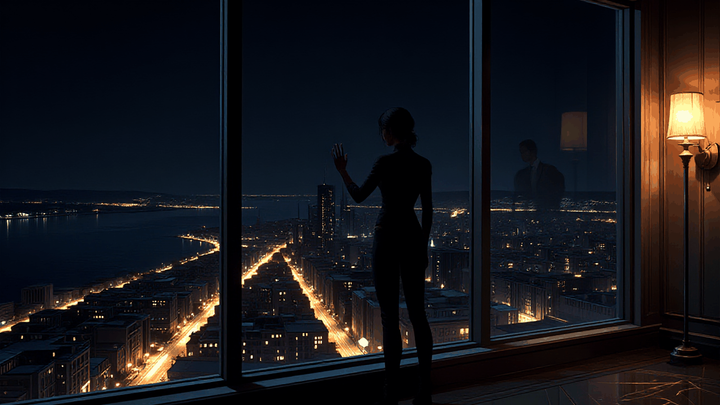
A structural engineer flies to Geneva for a conference and decides, for one night, to be no one at all — no name, no badge, no trail. She picks a stranger at a hotel bar and lets anonymity itself become the seduction. But morning brings a reckoning she never saw coming.
Good evening. I'm Lilith, and these are Letters to Lilith.
Tonight, a letter arrives from a woman who has spent her whole career being known. Stamped, badged, credentialed, findable at every hour by every firm she's ever worked for. She flew to Geneva for four days of conference rooms and lanyards, and on her last night, she decided she wanted exactly one thing: to walk into a hotel bar as a woman nobody could place.
No name. No firm. No trail. Just a stranger in a grey suit, three stools down, watching the lake like it owed him an answer — and a whiskey going warm between her hands while she decided just how far she was willing to disappear.
She got her anonymous night. What she didn't know was how long, and how far, that stranger had already been looking for her.
This is her letter.
Dear Lilith,
There is one night I never entered into any record: the night I refused to be known.
You have to understand what my days are made of. I am an engineer. I sign my name on drawings that hold up parking structures and pedestrian bridges, and every signature is a small contract: this will not fall down, and if it does, you can find me. My whole professional life is a trail of documentation. Stamped, dated, traceable. I had spent four days in Geneva at a conference on seismic retrofitting, four days of name badges and firm-branded lanyards and men in expensive shoes asking where I was staying, who I worked for, whether my husband minded the travel. I don't have a husband. I have a flight at six in the morning and a hotel bar with a view of the lake, and on that particular night, after the last panel and the last handshake, I wanted exactly one thing: to be a woman nobody could place.
The bar was on the top floor, all brass and low lamps, a violinist packing away her case in the corner like the night itself was closing early. I took a stool at the end of the zinc counter, ordered a whiskey neat, and set my badge lanyard in my coat pocket where it belonged. No name. No firm. No conference. Just a woman in a black dress with tired feet and a glass sweating a ring onto the bar.
He was three stools down, and I noticed him the way you notice weather changing, before you can say exactly why. Grey suit, no tie, jacket open. Not handsome in the obvious way. His features were too deliberate for that, a jaw that looked carved rather than grown, eyes so dark they read black in the low light. He wasn't performing for the room. He was watching the lake through the glass like it owed him an answer. When the bartender addressed him in French he answered in an accent I couldn't place, not quite Parisian, something worn smooth by too many borders.
I looked away first. That was the mistake, if it was a mistake at all. The deliberate ones usually feel that way, a decision dressed as an accident.
"You're not going to ask what I do," I said, when the silence between our stools had gone on a beat too long to be nothing.
He turned his head slowly, like the observation deserved consideration. "Should I."
"Everyone else here has."
"Then I won't." He said it simply, no charm laid over it, and something in my chest loosened that had been clenched since the first badge check on Monday.
"Good," I said. "Don't ask my name either."
That got the first real look from him, a flicker of something assessing and then, unmistakably, pleased. "As you like."
I want you to understand how deliberate this was for me, Lilith, not an accident of loneliness in a strange city. I had thought about it on the flight over, the specific freedom of a place where nobody would introduce me to anybody, where I could vanish into my own hotel room afterward and fly home a stranger to everyone I'd touched. I had never done it. I had always been careful, credentialed, findable. That night I wanted, for once, to be unfindable.
He moved one stool closer without asking, and the air between us went warm and close, warmer than the bar's climate control could take credit for. His hand was near mine on the bar, not touching, just present, and I found myself watching it — the way his fingers curled loosely around his glass, blunt and certain, a working man's hands set incongruously against a banker's suit.
"You have the look," he said, "of a woman who has just spent four days being extremely competent in a room full of men who needed reminding."
I laughed before I could stop myself, surprised into it. "Something like that."
"And now you'd like to not be competent for a while."
"I'd like," I said, choosing the words with the same care I gave load calculations, "to not be anyone at all."
He held my gaze a moment too long for comfort and not nearly long enough for what I wanted. "I can help with that."
We didn't touch for another twenty minutes, and that was its own kind of exquisite torment. The two of us angled toward each other on our stools, trading half-sentences about the lake, about the particular arrogance of Swiss punctuality, never once trading a fact that could be checked. He asked what I was drinking and why. I asked nothing about him at all, and he seemed to like that more than any question I could have posed. Somewhere under the conversation my whole body had gone taut and aware, the way it does before a storm breaks, every inch of my skin conscious of the two feet of air between his knee and mine.
When he finally touched me it was just his fingers, light against the inside of my wrist where it rested on the bar. He didn't grip. He traced, once, slow, the way you'd test whether something was as warm as it looked.
"Tell me," he said, voice dropped low enough that it stayed between us and no one else in that hushed room, "if I've read this wrong."
"You haven't."
"Say it anyway."
I turned my wrist under his fingers, an offering. "I want you to take me upstairs and I don't want you to ask me anything else tonight."
Something moved behind his eyes, gone before I could name it, and later I would understand it was the closest he came all night to flinching. At the time I only registered how his jaw tightened, how his hand closed fully around my wrist, warm and sure. "Then we should go before I lose the nerve to be a gentleman about it."
He left bills on the bar without checking the total. I remember that, the carelessness of it, a man who didn't need to count.
The elevator was mirrored on three sides, and the doors had barely sealed before his mouth was on my throat, one hand braced flat against the wall beside my head and the other sliding up the outside of my thigh, dragging my dress with it. I watched us in the mirror, his dark head bent to my neck, my own face flushed and slack in a way I never let it be flushed and slack in daylight, and the sight of it, a woman being wanted with no name attached to the wanting, stripped the last thread of my composure faster than his hands did.
"You'll ruin the dress," I managed, though I made no move to stop him.
"I'll buy you another." His mouth moved along my jaw, unhurried despite the greed in his hands. "Or you'll wear it ruined and think of tonight every time you put it on."
His fingers found the seam of me through the fabric, pressed and circled with a precision I knew from my own hands at a drafting table, deliberate to the millimeter, and I had to bite down on the sound that wanted out of me, hips already tilting into his hand before I'd decided to let them. The numbers over the door climbed, floor by floor, and I understood I had maybe ninety seconds left of being merely aroused before I'd be something considerably less composed, and I did not care.
The doors opened onto a hallway of soft carpet and softer light, and he didn't let go of my hand the whole walk to the room, his thumb moving over my knuckles in a way that felt, absurdly, tender, at odds with the hunger still humming off him. He fumbled the key card once, cursed under his breath in French, and I laughed, and he looked at me like the laugh had cost him something.
The room was floor-to-ceiling glass on the lake side, the city spread out below in a smear of gold and white, the water black and glossy beyond it. He didn't turn on the lights. He didn't need to. The room glowed with borrowed city-light, enough to see by, not enough to be seen from outside, or so I told myself in the part of my mind still capable of telling myself anything.
He turned me by the shoulders to face the window before I understood what he meant to do, my palms coming up against the cool glass instinctively, the lights of Geneva glittering below like something I could fall into. His hands settled at my hips from behind, thumbs pressing into the dip above the bone, and his mouth found the curve of my shoulder where my dress had slipped.
"Anyone could look up," I said, not a protest, barely even a warning, more a fact laid on the table between us.
"No one's looking up." His voice was rough now, closer to unraveled than it had been downstairs. "But if they were, they'd see a woman who knows exactly what she wants."
He dragged the zipper of my dress down slow, one long unbroken pull, and the fabric loosened and gaped and I felt the air of the room against my spine for the first time, cool where his mouth had left heat. He didn't take the dress off. He pushed it forward off one shoulder, then the other, until it pooled loose at my waist and I stood there in the window's glow in nothing but what I'd worn underneath, his hands sliding up my bare ribs like he was memorizing the architecture of me.
"Please," I said, and I have never in my life said that word to a man whose surname I didn't know, and I have never meant it more.
He answered by working my underwear down over my hips, his palm flattening low on my stomach to hold me still against him while he freed himself with his other hand, fast, no ceremony left in it now. I heard the give of his belt, the drag of his zipper, and then the blunt press of him against me, and I pushed back into it, impatient, done waiting.
He entered me in one long thrust that stole my breath entirely, my palms flat against the glass, my forehead dropping until it nearly touched the cool surface, a broken sound leaving me that I didn't try to hold back. He didn't move slow. There had been slow downstairs, over drinks, over twenty minutes of not-touching that had done half this work already. Now he drove into me hard and steady, one hand gripping my hip and the other fisted gently in my hair, angling my head so my cheek pressed the glass and I could see us both reflected faintly in it, ghost-pale over the lit city, his body braced over mine.
"Look at you," he said against my ear, voice wrecked, "taking exactly what you came here for."
I couldn't have answered even if I'd had words left. The angle of him inside me, the glass cold against my palms and getting colder as my skin heated, the drop of the city thirty floors below like the whole world was watching and none of it mattered because none of it knew my name. It built in me fast, faster than I expected, a tightening low in my belly running well past any margin for politeness. He shifted his hips, found some angle that dragged a cry out of me I didn't recognize as my own voice, and kept it there, relentless, one hand sliding around to press two fingers hard against my clit in time with each thrust.
"That's it," he murmured, "that's it, don't hold it back, no one's going to know but me."
I broke apart against the window with his name unspoken between us, my whole body seizing around him, a cry I muffled against my own forearm because some animal part of me still didn't want the hallway to hear even as the rest of me had stopped caring about anything at all. He didn't stop moving, drew it out of me in aftershocks, and only when I'd gone boneless and shaking against the glass did he finish, low groan at my ear, his forehead dropping to my shoulder, both of us breathing like we'd run somewhere together.
We ended up on the bed eventually, my ruined dress a dark pool on the carpet, the two of us tangled in the sheets while the lake outside went from black to the first bruised grey of almost-dawn. He traced lazy circles on my hip and I let myself drift half toward sleep against his chest, thinking, with the drowsy satisfaction of a woman who has gotten exactly what she came for, that I would never see this man again and that this was the entire point.
I woke to grey light and an empty bed beside me, and for one unsteady moment I thought he'd simply gone, the way anonymous men in stories are supposed to go. Then I saw him at the window, dressed again, watching the lake the same way he'd watched it at the bar, like it owed him something.
"You're still here," I said.
"I wanted to see your face when you woke," he said, "before I told you something you're not going to like."
I sat up, pulling the sheet with me, some old instinct toward armor reasserting itself. "I said no questions. I think that covers no confessions, too."
"This isn't a confession." He turned from the window, and in the flat morning light I saw something in his face I'd missed the night before, a tiredness that ran deeper than travel, a man who had been carrying something heavy for a very long time. "My name is Adélard. I know yours. I've known it for eight months."
The floor of the room seemed to tilt under me, and no amount of last night's whiskey could account for it. "That's not funny."
"It isn't meant to be." He crossed to the chair where his jacket hung and drew a folded paper from the inside pocket, held it out but didn't hand it over yet, like he needed me to be ready first. "There's a man named Étienne Rondeau. He died eleven months ago. He left a trust for his granddaughter's medical care, structural enough to keep her alive on a machine that isn't cheap and isn't optional. The trust requires the signatures of every surviving party named in his original will, notarized, before it releases. There were four names. Three signed within a month. The fourth was you."
"I've never heard of him."
"You wouldn't have. He was your father's business partner, forty years ago, before you were born. You inherited a nominal interest in a shell company neither of you knew still existed until his estate lawyer found it buried in paperwork. You are, legally, one signature the child needs and doesn't have." His jaw worked. "The girl is my sister's daughter. I have spent eight months finding you, three continents, four false addresses, because every week without your signature is a week closer to the machine being turned off for lack of funds."
I sat very still, the sheet clutched to my chest, trying to hold two entirely incompatible facts in my hands at once: that the night I had built out of pure, consequence-free want had been the culmination of something that had been shaping my life in secret for the better part of a year, and that the man who had just taken me apart against a window had known my name the whole time and let me believe he didn't.
"You could have just told me at the bar," I said, and I heard how thin my voice had gone.
"I told myself that for eight months," he said. "Every city I found you in, I told myself, tonight I introduce myself properly, I explain, I ask you to sign the papers, and I go home to my sister with good news. And every time, I watched you and thought, she does not know a single soul in this city, and I do not have to be the man asking her for something. For one night I could just be a man she chose." He set the paper down on the bed, unopened toward me, an offering rather than a demand. "I am not sorry for last night. I am sorry I let it start as a lie, even by omission. The papers are real. The girl is real. What happened at that window was not a means to get you to sign anything. I would have found another way to ask, eventually. I chose the harder truth of letting you meet me first as no one, because I wanted, once, for a woman to want me before she knew what I needed from her."
I sat with that for a long moment, the grey light strengthening outside, my flight ticking closer on some clock I'd stopped tracking. I could have been angry. Some part of me was. But under the anger was something stranger and more honest: I had gotten exactly what I asked for at that bar, a night with no name attached, and the fact that his name had turned out to matter enormously didn't undo what my body had chosen in that elevator, against that glass. I had wanted him before I knew a single fact that could be checked. That much, at least, hadn't been a lie either.
"Show me the papers," I said.
I read them at the small desk while he made coffee neither of us had asked for, and everything he'd said held up against the documentation the way a good structural drawing holds up against a stress test. I signed where the notary had marked, my hand steadier than I expected, and when I looked up he was watching me with an expression I didn't have a tidy word for, gratitude tangled up with something that looked uncomfortably like hope.
"Thank you," he said, "for last night, and for this morning, though I know they don't cancel each other out."
"They don't need to," I said, and found I meant it. "I got what I wanted at that bar. You got what you needed. I don't think either of those has to apologize to the other."
I made my flight with eleven minutes to spare, his card in my coat pocket beside the badge lanyard I'd hidden the night before, not because I planned to call, but because I liked knowing it was there. Anonymity and being known, it turns out, aren't opposites so much as two doors into the same room. Somewhere over the Atlantic I thought about the glass, the city below us, the particular fearlessness of choosing a stranger and being chosen back with a hunger that turned out to be twice as complicated as it felt in the moment, and I decided I would not trade a second of it, not the not-knowing, not the knowing after.
Lilith, I tell you this because I think you understand better than anyone what it means to walk into a room a woman no one can place, and take exactly what you came for before the world has a chance to attach a name to your wanting. I did not go to Geneva looking for a revelation. I went looking for one clean, anonymous night, and I got both, and I have stopped believing they were ever really separate.
With everything I took and kept,
Brittny
And so...
She went looking for one clean night with no name attached to it, and she got exactly that, and something else besides. She didn't apologize for either. That's the part I want you to sit with, darling: you are allowed to want the risk itself, the not-knowing, the stranger across the bar, purely because it's yours to want. Explore it. You don't owe anyone an explanation for what makes you feel most like yourself.
Next week, the last letter of our first season — and it comes home to Pisces. A woman who has spent her life halfway into her own dreams meets a lover patient enough to walk the rest of the way in with her, where romance is a spiritual and a sensory thing at once. We're calling it The Waking Dream, and dear listener, I have been saving it for you.
Until then... I'm Lilith. I left Eden so you wouldn't have to. Now go and explore your pleasure.
Want to live this one together? The Encore for “The Anonymous” — a re-enactment kit for you and your partner.