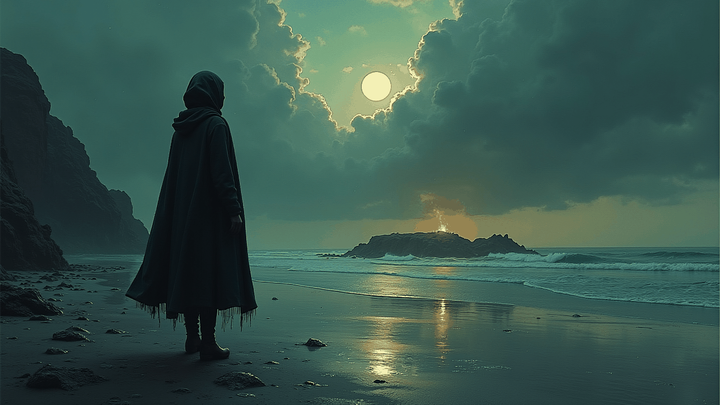
She walked the cove every dusk for a year and called it remembering. On the anniversary, the tide went out further than she had ever seen, and a fire was burning on the far spit that she did not light.
Good evening. I'm Lilith, and these are Letters to Lilith.
Welcome to a new season. Tonight our first letter arrives from a daughter of Cancer, the tidal heart, a woman who feels everything in fathoms and whose desire rises and recedes with an intimacy she cannot fake. I read her as the woman whose softness is not the absence of a shell, but the choice to leave it open.
Her name is Oona. She lives on a salt-worn coast where the fishing boats go out and sometimes do not come back. A year ago she lost the man she loved to the sea, and since then she has walked their cove every dusk and called it remembering, because calling it anything else would have meant she still hoped, and she is a practical woman who does not waste herself on things the world has finished with.
But last night was the anniversary. The tide went out further than she had ever seen it bare the seabed, and on the far spit of rock where no one goes, a fire was burning that she did not light. So she walked toward it, across the uncovered floor of the sea, expecting grief. She found something else.
This is her letter.
Dear Lilith,
I have walked that cove every dusk for a year, and for a year I have called it remembering. I told myself the shore was where I went to miss him, that the salt and the gull-cry and the slate under my boots were just the scenery grief chose for itself. I was so careful with that story. I held it the way you hold a cracked bowl level, terrified of the one tilt that lets everything run out. I did not let myself call it hope. Hope would have meant I believed he could still be reached, and I am a practical woman, Lilith, practical the way the sea is practical, and I do not waste myself on things the world has finished with.
A year ago the fishing boat went down in the spring storm with Diarmuid at the helm and three other men below. They recovered two bodies over the following week. His was not among them. The parish held the rite anyway, and I stood in the back of the chapel with dry eyes and my hands folded so tight the knuckles went white, because I am the woman who holds together, and I did not yet understand that holding together and holding shut are the same motion when you do them long enough.
The cove is where we met. I should say where we lived, in the years before the boat, because that shingle was ours the way a room is yours when you have memorized its every draft and warm board. He would build a fire on the spit when the tide went out and we would sit with our backs to the storm line and talk about nothing, or not talk, and the not-talking was the better part. After he crossed I started walking there at dusk because the cove was the one place that still held his shape, and I thought that if I sat long enough in the place where he had been, the wanting might settle into something I could carry without it cutting me.
It did not settle. It never settled. But I kept walking.
Last night was the anniversary. I knew the calendar without looking at it. My body knew. I woke with the taste of salt in my throat and a restlessness in my hands I could not explain, and by the time the sun dropped behind the headland I was already pulling on my cloak and boots and taking the cliff path down to the cove, moving faster than I had in months, propelled by something I refused to name.
The tide was out. I stopped at the top of the shingle and stared, because I have known that cove my whole life and I have never seen the water retreat that far. The seabed lay bare and glistening, a road of dark sand and exposed weed and tide pools catching the last green light, stretching all the way out to the spit and beyond it to the place where the cove opens to the open sea. You could have walked to the horizon on that bare ground. The rocks I had never seen the tops of stood up like the spines of something buried.
And on the far spit, where the fire pit sat cold for a year, a fire was burning.
I did not light it. No one lights it. The cove is half a mile from the nearest cottage along a path that floods at high water, and there had been no one on the strand when I came down the cliff. The fire burned gold and steady in the storm-lit dark, small and very real, and I stood there with the wind pulling at my cloak and I told myself it was a trick of the dusk, a fisherman's lantern, a thing that would have an ordinary explanation if I could just stop my heart from trying to climb out of my chest.
I walked toward it. I do not know how else to say it. Every sensible part of me, the part that has kept the cottage and the nets and the accounts for a year without help, said to turn back. I walked toward it anyway, down across the wet seabed, my boots finding the ridges of sand the retreating water had carved, and the ground under me was real and cold and stank of uncovered sea, and the fire did not recede or fade. It grew.
I could see him before I believed what I was seeing. A figure crouched at the fire, feeding it a length of driftwood, and the shape of his shoulders, the breadth of his back, the particular way he held his head when he was concentrating, were so familiar that my legs stopped working and I stood ankle-deep in a tide pool and simply could not move. I think I stopped breathing. I know my hands were shaking.
He stood. He turned. And the firelight caught his face and it was Diarmuid, exactly Diarmuid, the line of his jaw and the scar at his temple from the gaff hook and the way his hair fell across his forehead in the same unruly wave, and his gaze held mine across forty feet of uncovered seabed with an expression I will carry for the rest of my life, which was patience finally, finally answered.
I could not speak. He could. He came toward me, slow, the way you come toward something wild that might bolt, and when he was close enough I put my hand out and laid it flat against his chest and felt the rise and fall of his breathing, the warmth of him, the solid architecture of ribs and muscle under my palm, and I said his name, and my voice broke clean in half on the second syllable.
"You came," he said. His voice was the same. Low, unhurried, the western-island music in it. "I thought you might not. I thought you might not be ready."
"You're dead," I said, because that was the truest thing I had, and I needed him to hear it and to answer it, because I was standing on the uncovered floor of the sea talking to a man the parish had buried.
"I crossed," he said. He covered my hand with his, pressed it flat against his chest so I could feel the heartbeat under it, steady and real. "When the boat went, I crossed. But I didn't go on, Oona. I stopped here. The shore between. I couldn't go further knowing you were still on the other side of it."
I pulled my hand back. Not because I didn't believe him. Because I believed him too much, and the believing was a door I had spent a year nailing shut, and he was standing on the other side of it with a crowbar.
"You've been here," I said. "A year. This shore."
"Every night." He gestured back toward the fire, and I saw then that the spit was not the spit I knew. It was the same and not the same, the shapes elongated, the light stranger, the water at the cove's mouth luminous with a blue that does not belong to any earthly tide. "I build the fire every night. Most nights the path doesn't clear. The water stays between us. But once a year, on the night the veil runs thinnest, the tide goes all the way out, and the path opens, and I wait to see if you'll walk it."
A year. He had spent a year crouched at a fire on a shore between the living and the dead, watching a tide that would not retreat, waiting for one night that might or might not bring me to him. The weight of it sat on my chest like a stone. I had spent that same year walking to the very edge of the water and stopping, telling myself the sea was a boundary, that the far shore was memory and nothing more, and the whole time he had been right there, tending a fire I could have walked to if I had believed the path was real.
"Why didn't I see it," I whispered, and it was not a question. I knew why. Because seeing it would have meant the wanting was not grief but a thread still tied between us, and I could not bear to hold a thread I thought went nowhere.
He drew me back toward the fire, and I let him, because the wind was rising and the seabed was growing darker and I was shaking, and not entirely from cold. He settled me on the flat rock by the fire pit and pulled his own cloak from his shoulders and wrapped it around mine, and the wool smelled like him, like peat smoke and salt and pine resin and the particular warm skin-smell of a man who has been working with his hands, and I buried my face in it and my composure, the careful structure I had maintained for twelve months, cracked along every seam.
I did not rush to him. I want you to understand that, Lilith, because it is the thing I least expected of myself. I had imagined, in the weak moments I would never confess to, what I would do if I could have one more hour with him. In those imaginings I threw myself at him. I was desperate and graceless and I did not care. Standing there with his cloak around me and his fire between us, I found that I could not do it. The wanting was enormous, a physical weight behind my ribs, but layered over it was a terror so sharp it took my breath: the knowledge that this night had a tide, and the tide would turn, and every touch I gave away was a touch I would later have to account for to an empty bed.
So I rationed it. I sat by the fire and I watched his hands feed the flames and I let myself look at him the way a starving woman looks at a table she is afraid to sit down to, because sitting down means there will be an end to the meal.
"You're counting," he said, low.
"I'm not."
"You are. You've been counting since you got here. The tide, the light, the hours." He did not say it with reproach. He said it the way he said everything, plainly, with that patience that used to drive me to shouting when we were alive together and I wanted him to react to something. "You're already preparing for the leaving."
"I'm preparing for the dawn," I said, and it was the truest, most frightening sentence I have spoken aloud in my life, worse than any confession, because it named the thing I had been circling since I saw the fire. "I am afraid of the dawn, Diarmuid. I am afraid of every minute that brings it closer."
He went still. The fire crackled between us. Out on the luminous water, the blue light pulsed once, slow, like the breathing of something vast and patient.
"Then don't spend the night being afraid of it," he said. "Spend it here."
I crossed the firelight to him. I did it in pieces, the way I do everything that matters, one step and then a breath, and then another step, because my nature is not to rush but to close and retreat and close again, and I was trying, Lilith, I was trying so hard not to retreat. I knelt beside him on the shingle and I put my hands on his face, both of them, and I held it the way you hold a thing you have been given back from the deep, careful and disbelieving and gripping, and the stubble under my palms was real, and the warmth of his skin was real, and when I leaned forward and pressed my forehead to his, his breath touched my mouth and it was the same breath, warm and carrying the ghost of woodsmoke, and I had to stop and just breathe there for a long moment because the reality of him was a wave that kept breaking over me and I kept trying to stand up in it.
"I don't know how to do this knowing it ends," I said against his mouth.
"You don't do it any differently," he said. "You just do it."
He kissed me then, and I had been kissed by this man a thousand times and I had thought, this past year, that I remembered exactly what it felt like, and I was wrong. Memory is a poor copy. His mouth was warm and certain and it opened mine the way it always had, with the slow thoroughness of a man who treats kissing as the main event and not a doorway to something else, and I made a low raw noise into it that I could not have stopped if my life had depended on it, and my hands slid from his face to the back of his neck and I held on.
He undressed me slowly. Not with the teasing slowness of a man performing patience, but with the hands of someone relearning a coast he has sailed a thousand times, finding each fastening and recalling it, my cloak pin, the tie at my throat, the buttons of my wool dress, each one undone with his eyes on my face as though he was reading the tide of my expression to know whether to continue. I let him. I stood in the firelight and the storm wind and I let him take each layer, and when the cold air found my skin I shivered, and he pulled me against him, fully clothed, and held me there until the shivering stopped, and the heat of him through his shirt was so startling and so familiar that I pressed into it and felt my whole body soften against my will, the armor I had built out of grief and routine and long dusk walks cracking apart against the simple fact of his chest.
I undressed him after that, and my hands were steadier than I expected, because this I knew. The buttons of his shirt, the calluses on his palms, the scar along his ribs from the gaff that had nearly taken him years before the sea finished the job, the warm salt-skin smell of him that I had tried and failed to bottle in memory. When I got his shirt off I spread my hands flat on his chest and stood there, eyes closed, just feeling the heartbeat, counting it, confirming it, because some corner of my brain still required proof.
"You're checking," he murmured, and there was a roughness in his voice now that had not been there at the start.
"I'm confirming," I said. "There's a difference."
He laughed, low, and the sound of it, real and unguarded and right there in front of me, broke something loose in my chest that I had not known was still held. I pulled him down to the cloak I had spread on the shingle, and he came, and the storm chose that moment to open properly, rain coming in gusts that hissed in the fire and stippled the tide pools around us, and we were half-sheltered by the overhang of the great rock and half not, and I did not care.
He laid me back on the cloak. I could find a graceful sentence for it, but I am tired of graceful sentences. Here is the plain shape of it: the wool was rough under my shoulder blades and the rain was cold on my shins and the fire threw our shadows long across the bare seabed, and when he knelt over me I reached up and touched the rain on his jaw and I was not anywhere else. I was not in the cottage. I was not on the cliff path. I was not in the chapel pretending to mourn. I was exactly, only, here, with the man I had lost, on a shore I had spent a year refusing to believe was real, and the truth of that was so large and so simple that it emptied me of every clever thing I had told myself about closure.
"You're beautiful," he said, and it was not a compliment. It was a report. The way a navigator reports a bearing. He said it the way he said everything true, as though the fact of it was more important than whether I was ready to hear it, and his eyes moved over me in the firelight with the same attention he used to give the tide tables, thorough and unhurried and hungry in a way he rarely let show.
He bent and kissed my throat, my collarbone, the place below my ear where my pulse was hammering, and I arched into it because I had forgotten, in a year of holding still, how much my body wanted to be touched by hands that knew it, and his hands did know it, they found the places that made my breath catch as though he had a map of them, the curve beneath my breast, the dip of my waist, the inside of my wrist, and each touch landed like a word in a conversation we had paused a year ago and were now, impossibly, resuming.
His mouth traveled down. I felt it on my sternum, on my ribs, in the hollow of my belly, and I understood where he was going and I wanted it so fiercely that the wanting itself frightened me, because wanting is the thing that survives loss, and I had been trying to kill it.
"Diarmuid," I said, and it came out like a question I did not mean to ask, which was: is this real, are you real, will you still be here when I open my eyes.
He answered by pressing his mouth to the inside of my thigh, warm and deliberate, and my hips rose off the cloak without my permission. He held them down. One broad hand flat on my stomach, the same steadying gesture from years ago, and I heard myself make a sound that was half relief and half fury, because he had always done this, always made me wait, and I had always wanted to kill him for it and loved him for it in the same breath.
He was unhurried. He kissed the soft skin of my thighs until I was shaking, and when his mouth found me it was with the same maddening, reverent thoroughness he brought to everything, slow and exact, learning me again as though a year apart might have changed the geography of what I needed. It had not. He found the rhythm that undoes me and he kept it, steady, and I twisted my hands in the cloak and in his hair and the storm broke harder over us and I did not care, I was past caring, I was a woman on a shore between worlds being loved by a dead man who had waited a year for the tide to let her come to him, and the scale of that and the physical reality of his mouth on me were the same thing, indistinguishable, heat and grief and gratitude all braided into one.
I came with his name in my mouth and the rain on my face, and it was not quiet, and I was not composed, and I did not try to be. The climax shook me the way the storm shook the sea, long and rolling, and he held me through the whole of it, his hands on my hips, his mouth gentle now, easing me down, and when I could breathe again I reached for him and found him shaking too, and the knowledge that he had been holding himself in check all this time, patient even now, cracked me open a second time, in a different register.
"Come here," I said, and pulled at him, and he came up over me, and I felt the full length of him, hard and warm and real against my thigh, and I wrapped my hand around him and his breath broke on a groan that I felt against my neck, and the sound of it, the rawness of a man who has waited, went through me like a current.
"Now," I said. "I'm not waiting anymore. I've waited a year. I'm done."
He came into me slow, watching my face, and I felt every inch of the long slide, and I held his gaze because looking away felt like a concession to the dawn I was not willing to make. When he was fully inside me we both went still, breathing hard, foreheads touching, and the rain ran down between our faces and I tasted salt and him and the storm.
"Stay," I whispered, and it was not a request he could grant and I knew it, but I said it anyway because my nature under threat of losing him is to hold tighter, not to let go, and I would rather have the word between us, spoken and impossible, than the tidy silence of a woman who pretends she does not mind the leaving.
He moved. Slow at first, deep, the same unhurried rhythm he had kept all night, and I met him, and my body remembered his the way the shore remembers the shape of the tide, and the pleasure built in long waves that I could not rush no matter how I tried, and I stopped trying, and I let it build the way it wanted to build, slow and total, and when it crested it took me under completely, my whole body clenching around him, and I heard myself say things I will not repeat because they were private and desperate and true.
He followed. Not at the same moment, not the neat twin climax of a story, but after, his own control at last giving way on a sound I had not heard in a year, his whole body going rigid over mine and then spilling into me with my name on his breath and his face buried in my neck, and I held him through it, my arms locked around his shoulders, my legs around his hips, refusing to loosen even a fraction.
We lay tangled on the cloak while the fire settled and the rain gentled. I ran my hands over every part of him I could reach, confirming, cataloguing, memorizing against the year ahead, and he let me, his eyes half-closed, his thumb tracing slow circles on my hip. The luminous water at the cove's mouth pulsed its slow blue breath. Somewhere out past the headland, the first gray was stealing into the sky.
"The tide's turning," he said quietly.
I knew. I had felt it twenty minutes ago, the first shift in the air, the faint change in the sound of the water. I had not said anything because saying it would make it real, and I had spent the whole night fighting the real.
I sat up. The seabed was still bare but the tide pools at the edges were filling now, brimming over their lips, and the path back to the mortal shore was still walkable but narrowing. I could see the cliff and the cottages beyond it, dark and ordinary and waiting.
"You could stay," he said, and his voice was steady, but I heard what it cost him to say it, and I heard too what it would cost me to refuse, and I understood in that moment the shape of the choice the shore had been offering all along. I could stay. I could cross with him, let the water close over the path, never go back to the cold bed and the empty accounts and the long dusk walks. It would be the easier thing. It would be the thing my body wanted, which was to dissolve into him and stop carrying the weight of living without him.
I looked at him, and I looked at the shore I had come from, and I made the choice that I think you, Lilith, of all people, would understand, which is the harder one.
"I'm going back," I said.
He did not flinch. He did not argue. He held my eyes for a long moment and then he nodded, once, and something in his expression settled into a kind of peace that I had not seen on his face all night, as though my refusal was the answer he had actually been waiting for, the proof that I was not coming to him out of despair but out of want, and that I could distinguish between the two.
"Next year," he said.
"Next year," I said. "And every year the tide lets me."
He walked me to the edge of the water. The path was ankle-deep now in the returning sea, cold and bright around our feet. At the last step, where the seabed met the mortal shingle, he took my face in his hands and kissed me, once, with the full unhurried weight of a man who has time, because he does, because he has all the time there is, and the only thing he lacks is me, and he will wait for me the way he waited this year, and I understand now that his waiting is not a punishment for either of us but the shape our love takes across the boundary neither of us chose.
I walked up the shingle without looking back, because if I looked back I would not keep walking, and I am the woman who holds together, and I held together, and I did not let myself fall apart until I was inside my own cottage door with my back against the wood and the salt and the rain still on my skin and the taste of him still in my mouth.
I did not sleep. I sat by the cold hearth in his cloak, which I had brought back with me, and I let the grief and the gratitude move through me in their own tide, and I did not try to dam either one, because I learned last night that the shell I built was never protection. It was just a way of being alone in a shape that looked like strength.
I will walk the cove every dusk as I have always done. But I will not call it remembering anymore. I will call it what it is. He is there. He waits. The fire burns. And once a year, when the tide goes out further than any sensible woman should walk, I will go to him, and I will choose, every time, with my eyes open and my hands steady, to be fully present in the body he loves, and to carry the ache back across the water like a lantern, because the ache is not the cost of having lost him. It is the proof that I have not.
With more love than the parish knows what to do with,
Oona
And so.
She went back, dear listener. Not because she stopped loving him, but because she understood that staying would have been the easier thing, and the easier thing is not always the true one. The shell she built around her grief was never protection. It was just a way of being alone in a shape that looked like strength.
So here is my encouragement to you tonight: whatever you are carrying, carry it openly. The ache is not the cost of having lost something. It is the proof that you have not stopped loving. Let your softness be a choice, not an absence. Leave the shell open.
Next week, a letter arrives from a daughter of Leo, a woman who has always been the one the room watches, stepping into a role where the only audience that matters is the one man who has never once looked away.
Until then. I'm Lilith. I left Eden so you wouldn't have to.
Want to live this one together? The Encore for “The Tide” — a re-enactment kit for you and your partner.